
How Much Does Link Building Cost?

Link building costs in the US market range from as little as $2 per citation link to $2,000 or more for a single high-authority placement — and understanding where your money actually goes is the difference between a smart investment and a complete waste of budget.
The link building pricing landscape is one of the most misunderstood areas in all of SEO, and that misunderstanding costs businesses real money every day. In this guide, I’ll walk you through what link building actually costs in the US market, what drives those costs up or down, and how to avoid the traps that waste your budget before you see a single ranking improvement.
The Biggest Misconception About Link Building Costs
The market is flooded with sellers offering hundreds of links for $50 to $200, and that creates a false price anchor in buyers’ minds. When someone sees a package promising 200 links for $99, it looks like an incredible deal compared to an agency charging $500 for a single guest post placement.
What most buyers don’t understand is that those bulk links — built on directories, web 2.0 blogs, and article-spinning sites — genuinely do not add authority to your backlink profile. Search engines have become extremely good at identifying links that carry no real trust signal.
I’ve watched dozens of businesses burn through $300–$500 on cheap packages, then come to me wondering why their rankings haven’t moved. Those links never had a chance of moving anything.
How Much Does Link Building Cost? A Real Pricing Breakdown
Here’s how I break it down across three tiers.
Foundational / Entry-Level Links Local citations, business listings, social profiles, and directory submissions form the foundation of any backlink profile. Tools like BrightLocal make this accessible — their Citation Builder starts at around $2 per link, with a starter pack at approximately $54/month. For small businesses or sites in low-competition niches, this tier alone can produce meaningful results.
Mid-Tier Guest Post Outreach This is where real authority-building begins. At WhiteLinksSEO, I charge around $500 to carry out guest post outreach targeting niche-specific sites — real sites with real organic traffic and genuine domain authority. I’ve secured placements on sites like brandvm.com for a New York-based experiential marketing client. These are the placements that add measurable trust and credibility to a backlink profile.
High-Authority Niche Placements For competitive sectors — law, healthcare, financial services, digital marketing — you need links that genuinely move rankings. These placements run from $500 to $2,000 or more per link, depending on the site’s metrics and the niche’s competitiveness.
| Link Type | Estimated Cost |
|---|---|
| Local Citations / Business Listings | $2/link or ~$54/mo |
| Guest Post Outreach (Niche Sites) | ~$500/campaign |
| High-Authority Niche Placements | $500–$2,000+ per link |
Where you invest depends entirely on your niche, your competition, and your current backlink profile.
What Actually Drives Link Building Costs Up or Down?
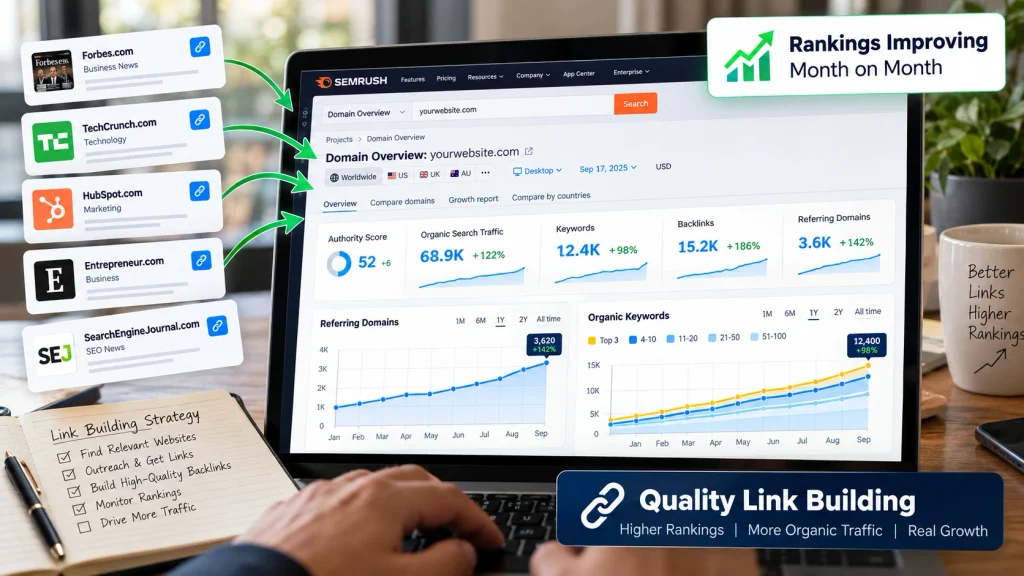
Time is the single largest cost driver — I estimate it accounts for roughly 50% of total effort, and it’s what most people underestimate when comparing price points.
Here’s the actual workflow at WhiteLinksSEO, so you can see exactly where the hours go:
- Competitor backlink research — Using SEMrush to identify which sites are linking to competitors and what value those links carry
- Metric vetting — Checking organic traffic trends, content quality, and audience fit; any site showing a 3–4 month traffic decline gets cut immediately
- Outreach — Contacting site owners or editors to confirm they accept guest posts
- Content creation — Writing an article that meets the target site’s editorial standards
- Placement and confirmation — Securing the live link and verifying it
That full process takes real hours from real people using real tools. SEMrush alone adds overhead that cheap providers don’t absorb, which means they cut corners — usually at the research and vetting stage, which matters most.
Niche competitiveness is the other major variable. A local bakery with no direct competitors needs far fewer high-authority links to rank than a personal injury law firm competing in a major US city. The more competitive the niche, the more effort every individual link requires.
Is It Worth Paying for Backlinks?
Yes — when you’re paying for quality. No — when you’re paying for volume without substance.
The clients I’ve worked with longest have been running guest post campaigns with me for multiple years. They keep investing because those campaigns have produced steady organic rankings, consistent leads, and measurable conversions. Not an overnight spike, but a durable upward trajectory.
Before hiring any link building service, ask these questions:
- What types of links will you build?
- What will the average domain authority of those links be?
- Can you show me examples of recent placements?
- How will these links improve my search engine visibility?
If a provider can’t answer those questions with specifics, that’s your answer. Monitor everything through Google Search Console and Google Analytics, ask for detailed reports, and ask follow-up questions after every one. This isn’t micromanaging — it’s accountability.
In-House vs. Outsourcing: Which Actually Costs Less?
An in-house team can handle foundational link building effectively — creating social profiles, writing blog content, uploading videos to YouTube, submitting to local directories. This forms a legitimate base layer for any backlink profile and is manageable without outside help.
The shift to outsourcing makes sense when two things happen: your foundational links are in place, and competitors are starting to outrank you despite that work. At that point, an experienced agency brings tools, established relationships with site owners, and the workflow discipline to secure placements an in-house team can’t replicate without significant investment in time and training.
The hidden cost most businesses miss is waiting too long to make that shift. The further you fall behind competitors in organic search, the harder — and more expensive — it becomes to close the gap. Recovering lost ground in competitive niches takes considerably more investment than holding your position would have.
The Hidden Cost Most Guides Skip: Time to See Results
Link building is a continuous process, and results often take six months or longer to show up in measurable traffic or lead flow. The most expensive mistake I see is businesses switching providers after three months because they don’t see immediate results — then starting the entire process over and losing all the momentum that had been quietly building.
If quality links are being built and your backlink profile is steadily improving, that’s not a signal to panic. That’s a signal to stay the course.
Here’s what consistent monitoring looks like in practice:
- Check Google Search Console monthly for changes in impressions, clicks, and average position
- Track organic session trends in Google Analytics
- Review every link building report and ask follow-up questions
- Look for gradual upward movement, not dramatic overnight jumps
Patience paired with accountability is what separates businesses that see long-term ROI from those that constantly restart.

Are Backlinks Still Relevant in 2026?
Yes — and their value is increasing. The arrival of AI-driven search has added an entirely new competitive frontier: businesses now compete not just for Google rankings but for citations in AI-generated answers.
For sites in low-competition niches, foundational links still produce solid results. The calculus hasn’t changed at that end of the market. But for competitive sectors — law, healthcare, marketing services — you need links that genuinely build authority, and that quality commands higher pricing. The effort required to earn a placement on a high-DA, real-traffic site is simply not compatible with $50 bulk packages.
According to a recent Moz study on link building ROI, quality backlinks remain among the top-ranking factors in competitive search — which aligns with what I see in practice every day.
What You Should Take Away
Here’s the short version: foundational links run $2 to $54/month, mid-tier guest post outreach sits around $500 per campaign, and high-authority placements in competitive niches can reach $500 to $2,000 or more per link.
Quality always outweighs quantity. A handful of placements on real, authoritative sites will do more for your rankings than hundreds of links from low-DA directories — every time.
Link building is a long-term investment, not a one-time purchase. The businesses I’ve worked with for multiple years are the ones seeing sustained organic growth. The ones who switched providers every few months are often no further ahead than when they started.