
How Long Until I See SEO Results? An Honest Answer From 17 Years in SEO
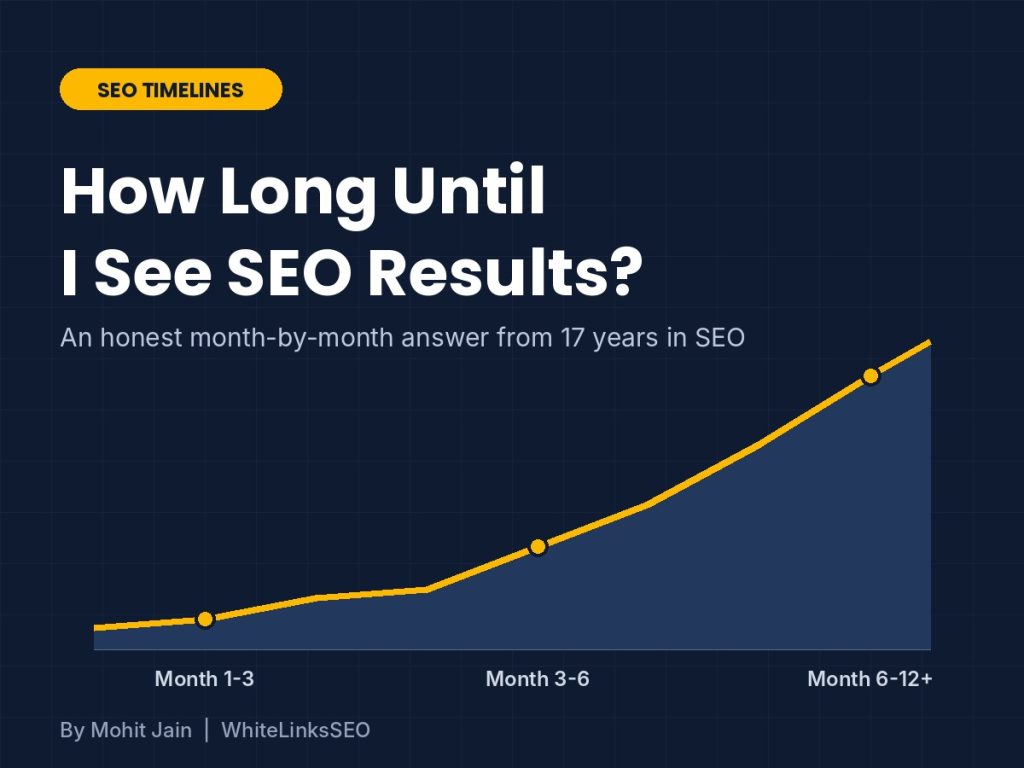
Short answer: Most businesses see the first real signs of SEO progress within 1–3 months: pages getting indexed, impressions rising and long-tail keywords appearing. Low-competition local keywords can reach page one in about 3 months. Competitive keywords in big markets usually take 6–12 months or more. How fast you move depends mostly on competition, your site’s authority and backlinks, and whether your website gives Google what it needs to understand your business.
I’ve been doing SEO for 17 years, and “how long until I see results?” is still the first question almost every client asks me. It’s a fair question. You’re investing money and you want to know when it pays off. Below is the honest answer I give my own clients, along with a real example and the data behind it.
What Google Itself Says About SEO Timelines
Start with what Google says. In its Search Central guide “Do you need an SEO?”, Google says it typically takes “four months to a year” from the time you start making changes until you see the benefits.
Industry data backs that up. In its 2025 ranking study, Ahrefs found that only 1.74% of newly published pages reached the top 10 within a year, and that most pages in Google’s top 10 are more than three years old. Ahrefs also advises that if a page still isn’t in the top 10 after about six months, you should improve it rather than keep waiting.
The takeaway: anyone promising page one in 30 days for a competitive keyword is selling something that doesn’t exist. But long timelines don’t mean you just sit and wait. There’s a lot you can control.
The Biggest Factor: How Competitive Your Keywords Are
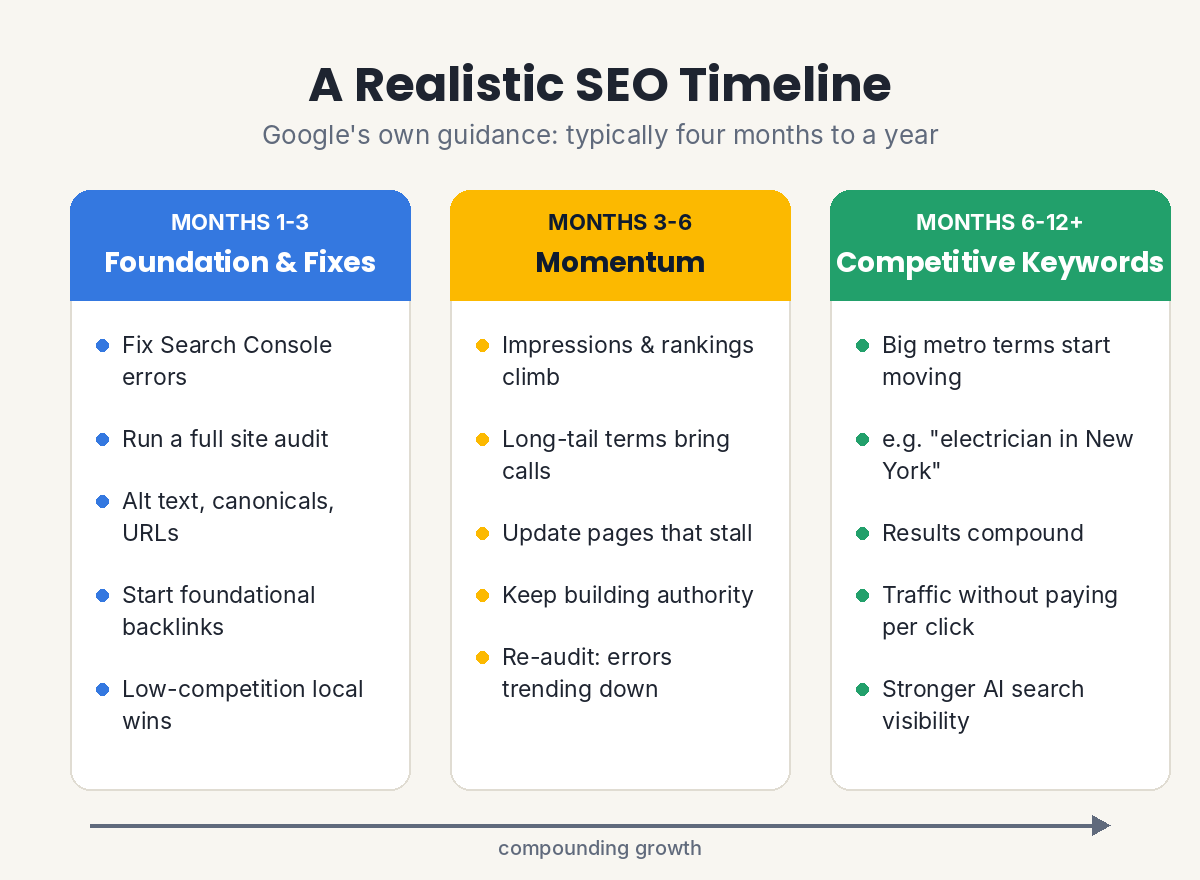
Whenever a client asks me about timelines, I start with competition, because it’s one of the biggest factors in how fast you see results. Here’s the example I use all the time:
- “Handyman services in Brooklyn”: a narrower area with fewer businesses competing for that exact phrase. Much easier to rank for.
- “Handyman services in New York”: a huge metro search where you compete with every established contractor, directory and aggregator in the city. Much harder.
Same service, completely different timelines. That’s why I usually recommend that local businesses win the specific, local, lower-competition searches first. Those wins bring in calls while we work toward the bigger terms.
Case Study: How a New Jersey Pawn Shop Ranked on Page One in 3 Months
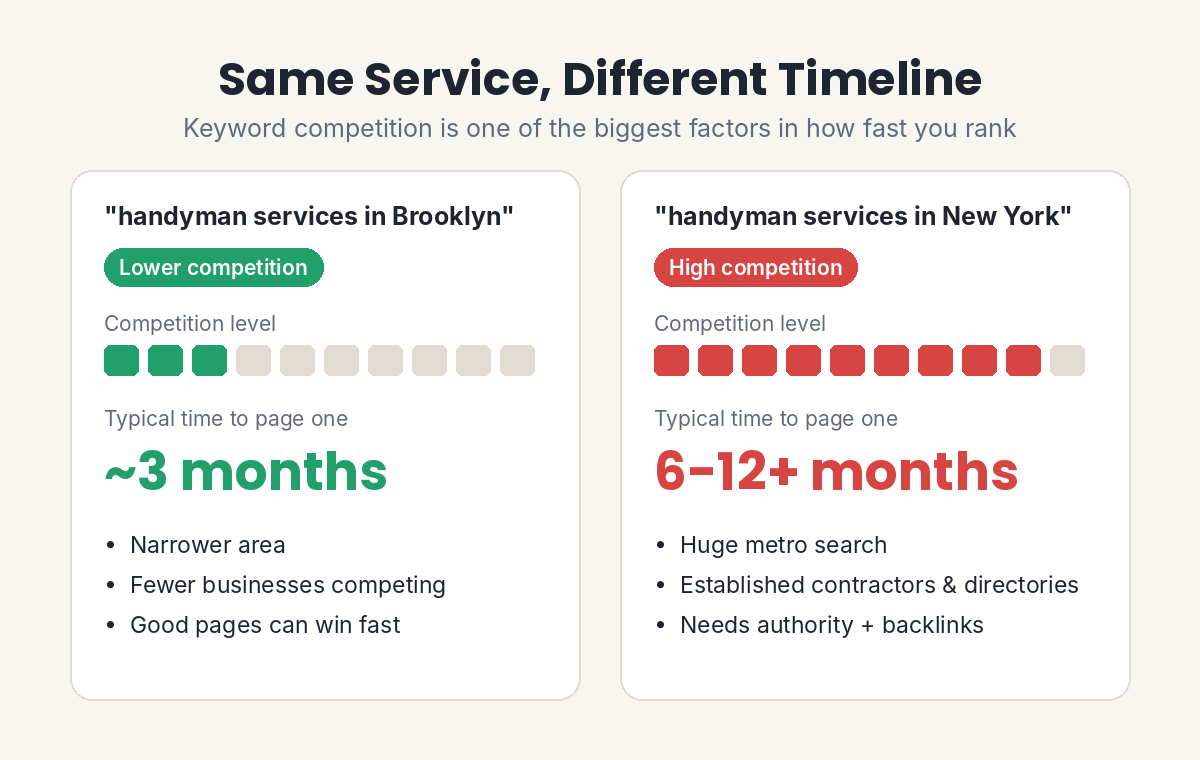
One of my favorite examples comes from a pawn broker in New Jersey with 4–5 locations.
The problem: They came to me with a list of keywords they wanted to rank for, mostly “pawn shop + [town]” searches. But their website had no location pages at all. That was the whole issue. If Google doesn’t know where you provide your services, you won’t rank for searches in those places.
What we did: We created an “Areas We Service” section listing the towns and counties where the business had physical shops. Each location got its own page with well-written content describing the services available at that specific shop. These weren’t copy-paste pages with only the town name swapped. Each one described a real shop and what customers could do there.
The result: The location pages ranked on the first page of Google for the targeted keywords within 3 months.
This matches what local SEO experts report. In Whitespark’s Local Search Ranking Factors survey, having a dedicated page for each service ranks among the top factors for local organic rankings. That’s expert opinion rather than confirmed Google policy, but it lines up with what I see with clients.
One important caution: location pages only work when they represent real locations with real, useful information. Google’s spam policies treat city pages that just funnel visitors to one page as doorway abuse. My client had actual shops in those towns and we wrote real content for each. That’s why it worked, and that’s the line you shouldn’t cross.
The contrast: Keywords like “electrician in New York” or “web design agency in San Diego” can take more than 6 months. Those markets are crowded, and Google weighs domain authority, backlinks, content quality and much more before it moves you past competitors who’ve been building those signals for years.
A Realistic SEO Timeline, Month by Month
Every site is different, but here’s how I set expectations with my clients.
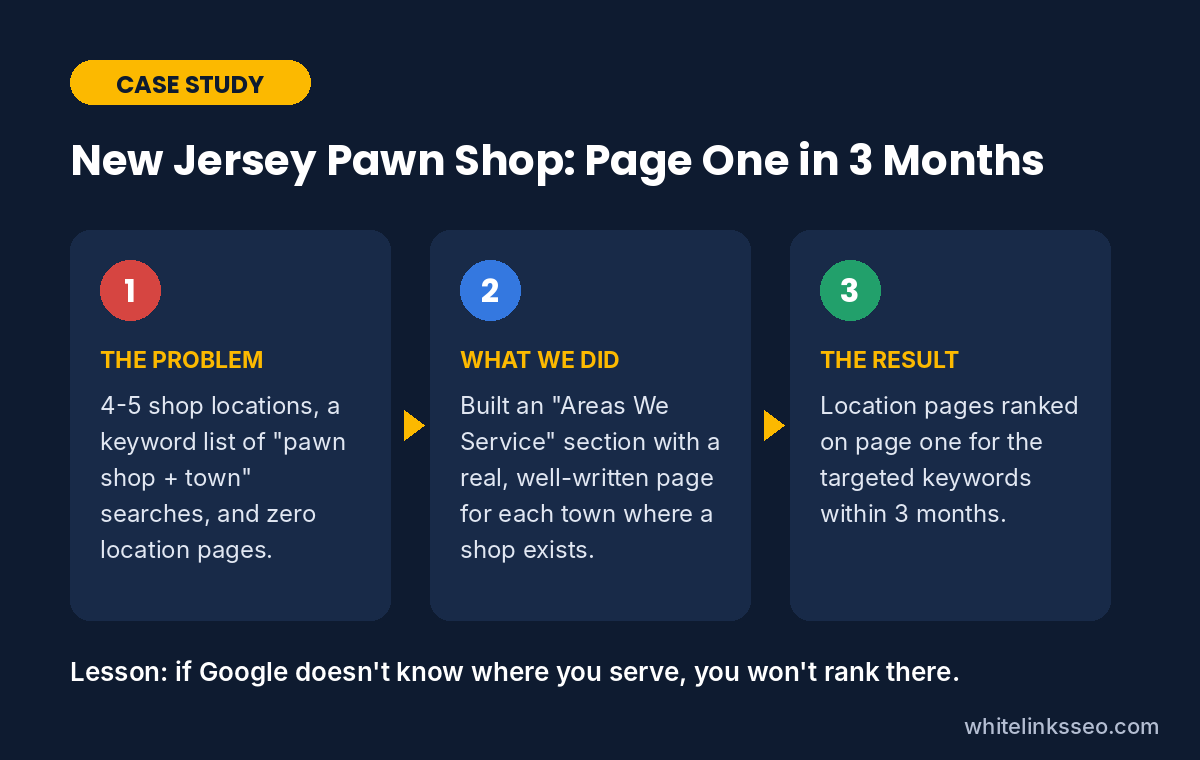
Months 1–3: Foundation and Fixes
This is setup and cleanup. You may not see big traffic jumps yet, but this is where future results get built.
- Google Search Console: Watch how Google is indexing your site and fix the page errors it reports. The Page Indexing report shows which URLs are indexed and why others aren’t.
- A full site audit: I use tools like Semrush to run a site audit and work through the errors. Small things get missed all the time, especially image alt tags and canonical links.
- Foundational backlinks: Start building quality foundational links now. Backlinks have a big impact on rankings. Ahrefs’ search traffic study found that the vast majority of pages get no traffic from Google at all, and a lack of backlinks was one of the main reasons. (Here’s what link building actually costs.)
- Early wins: Low-competition, local keywords can start ranking in this window, like they did for my pawn shop client.
Months 3–6: Momentum
- Impressions and rankings should be climbing in Search Console.
- Long-tail and local terms start bringing in calls and form fills.
- Pages that haven’t moved get reviewed and improved, not just left to sit.
Months 6–12+: Competitive Keywords and Compounding Growth
- This is when harder, high-volume keywords like “electrician in New York” can start to move, if the content, authority and backlinks are there.
- Results compound. Pages that rank keep earning traffic without you paying per click.
What Slows SEO Results Down
Most of the delays I see aren’t caused by Google. They’re caused by problems on the website. These are the most common:
1. URLs That Aren’t SEO-Friendly
A very recent client of mine had page URLs with no sensible structure, and we advised them to fix it. Google’s own URL structure guidelines recommend simple, descriptive words and hyphens between them. Compare /pawn-shop-trenton-nj/ with /page?id=48213. One tells Google and your visitors what the page is about. The other tells them nothing.
2. Slow Site Speed
A slow site frustrates visitors and holds back rankings. Google’s Core Web Vitals give clear targets: the main content should load within 2.5 seconds, the page should respond to clicks within 200 milliseconds, and the layout shouldn’t jump around while loading.
3. Low-Quality, Generic Content
This is the big one. Content that’s generic and doesn’t give people enough information leads to lower rankings, because Google won’t serve low-quality content to searchers. Google’s helpful content guidance is clear that its systems reward content created to benefit people, not content made to manipulate rankings.
I tell clients to think about it like this:
- Service pages are where you tell visitors what you do and show your expertise. Be specific about your services, process, locations and why you’re qualified.
- Your blog is where you publish helpful content. Keep it updated with the best information, tips, industry news and how-to articles. That builds trust with readers and with Google. Internal links then connect those posts back to your service pages.
How to Measure SEO Progress (and When to Worry)
You don’t have to wait a year to know whether SEO is working. Here’s what I watch.
Healthy signs in the first 1–3 months:
- Your pages show as indexed in Google Search Console.
- Impressions start appearing, even before clicks do.
- Page errors are getting fixed and staying fixed.
The re-audit test: After 1–2 months, run the site audit again. A significant number of the original errors should be gone. If they are, your foundation is getting stronger.
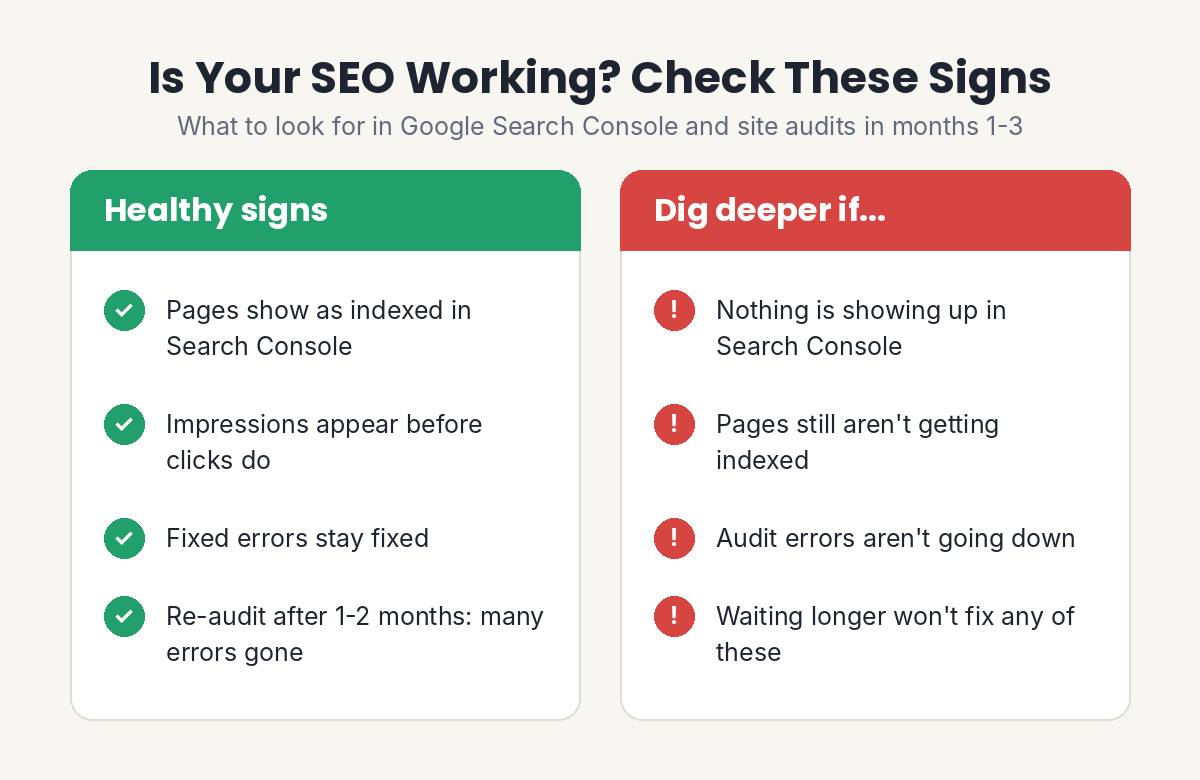
Warning signs that mean you need to dig deeper:
- Nothing is showing up in Google Search Console. That’s a red flag.
- Pages aren’t getting indexed after a reasonable amount of time.
- Audit errors aren’t going down between audits.
If you’re seeing these, waiting longer won’t fix it. Something is wrong with indexing, the technical setup or content quality, and it needs investigating.
Is SEO Dead Because of AI? My Honest Opinion
Agencies are promising very different things right now. Some say “SEO is dead” and want to sell you only AI-citation services. Others say “just publish more blog posts” and pull topics from tools like AnswerThePublic.
Here’s my view after 17 years: SEO isn’t dead. It’s changing.
Yes, SEO is slowing down as AI takes over more of the results page. Since AI Overviews arrived, people can find many answers right below the search bar instead of visiting a dozen sites. They read the answer and pick a service the AI cites. A Pew Research Center study from July 2025 found that people clicked a traditional search result in about 8% of visits when an AI summary appeared, versus 15% when it didn’t. Ahrefs found the top-ranking page’s click-through rate was 58% lower on average when an AI Overview was present. (Google has disputed Pew’s methodology, so treat the exact numbers as estimates, but the direction is clear.)
But here’s why I don’t buy the “SEO is dead” pitch: SEO done well is how you get cited by AI.
- Google’s own documentation on AI features says a page needs to be indexed and eligible to show in Search with a snippet to appear as a link in AI Overviews, and that no special optimizations are needed beyond that.
- Google’s Danny Sullivan summed it up at WordCamp US in 2025: “Good SEO is good GEO.” In other words, don’t panic.
- Being cited pays off. Seer Interactive’s 2026 analysis found cited brands earned noticeably more organic clicks than brands that weren’t cited.
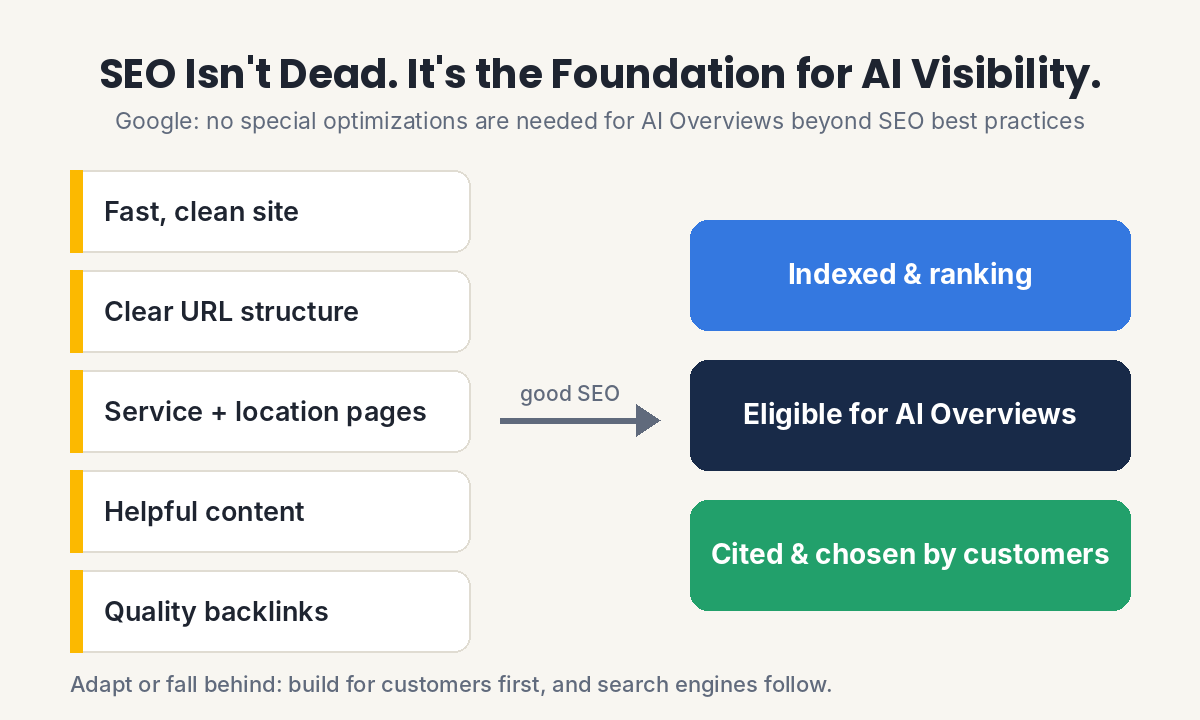
To be fair, ranking in the top 10 doesn’t guarantee a citation. Recent data shows AI Overviews also pull from pages ranking for related sub-queries. That actually supports my point: there’s no shortcut to AI visibility. You need a strong, well-structured site that covers your services and topics in depth, which is exactly what good SEO builds.
Adapting is survival of the fittest. If your business offers good services or products, and your website is built for your customers rather than for search engines, you will get results.
FAQ
How long does SEO take for a small local business?
For low-competition local keywords, often around 3 months, as long as your site has proper location and service pages. Google’s general guidance is four months to a year.
Why is my competitor ranking faster than me?
Usually it comes down to competition and authority. They may be targeting less competitive keywords, have more quality backlinks, or have an older, more established website.
Can I speed up SEO results?
Yes. Fix technical errors early, create dedicated pages for each service and each real location, write genuinely helpful content, and start building foundational backlinks from month one.
Do I need separate “AI optimization” on top of SEO?
Not for Google. Google says no special optimizations are needed to appear in AI Overviews beyond SEO best practices. Focus on quality, structure and authority.
When should I be worried?
If nothing shows up in Google Search Console after the first couple of months, your pages aren’t getting indexed, or your site audit errors aren’t going down.
Want to Know How Long SEO Will Take for Your Business?
Every timeline depends on your market, your competitors and the current state of your website. The quickest way to get a real answer is to look at your site. You can see some of the ranking results I’ve achieved for clients, or learn more about my SEO services.
I’ll review your indexing, technical errors, location and service pages, and backlink profile, then give you an honest assessment of what’s holding you back and how long realistic results should take.