
Google Is Moving to Default AI Mode – What Are the Implications for Traditional SEO?
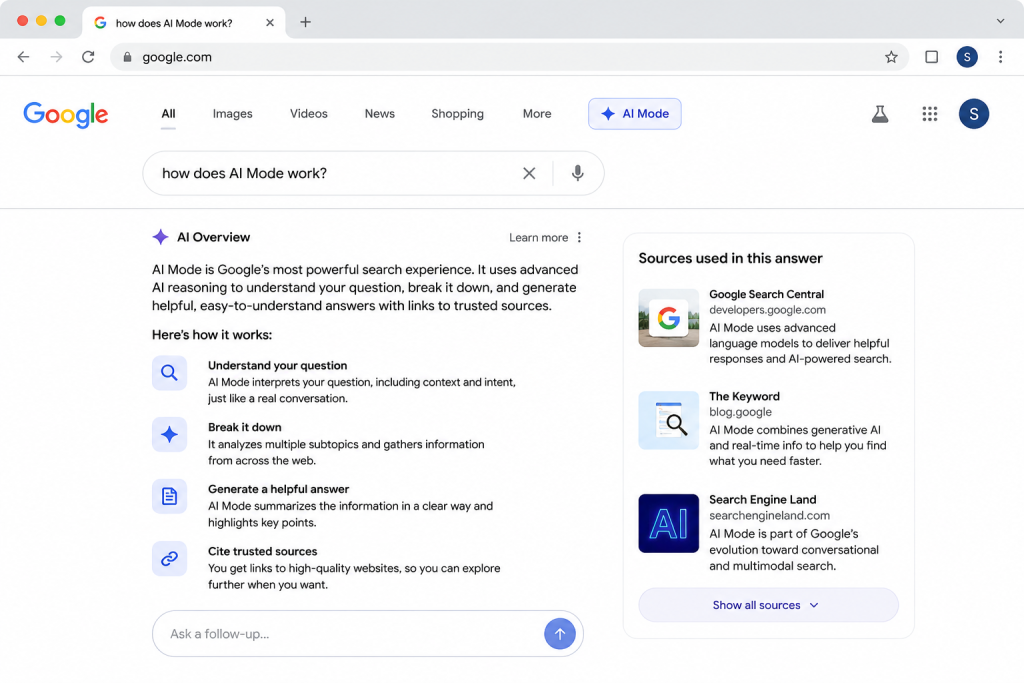
Google’s move towards AI Mode marks one of the biggest changes to search since the company was founded.
For years, SEO professionals focused on ranking web pages on Google’s first page. Businesses competed for the number one organic position because that was where the majority of clicks came from.
Today, the rules are changing.
Google’s AI Mode is designed to answer users’ questions directly within the search experience. Instead of displaying ten blue links and expecting users to visit multiple websites, Google now attempts to provide the best answer immediately while citing trusted sources.
Many people are asking whether traditional SEO is dead.
After working in SEO for many years and managing campaigns across multiple industries, my answer is simple.
No, traditional SEO is not dead.
But it is changing faster than ever before.
SEO Is Evolving from Keyword Rankings to Brand Visibility
For years, SEO success was measured by keyword rankings.
Businesses wanted to rank first for their target keywords because higher rankings usually meant more traffic and more enquiries.
Today, ranking alone is no longer enough.
The businesses that succeed in Google’s AI ecosystem will be the ones that are consistently cited as trusted sources.
SEO is becoming less about individual keywords and more about overall brand visibility.
If Google, ChatGPT, Claude and other AI platforms recognise your business as an authoritative source, your chances of being mentioned in AI-generated answers increase significantly.
That is where I believe SEO is heading.
How AI Mode Is Changing User Behaviour
AI Mode is fundamentally changing how people search.
Instead of clicking through multiple websites to find answers, users can now ask follow-up questions directly inside Google and receive comprehensive responses without leaving the search results.
For many informational searches, the journey now ends inside Google’s AI experience.
Users will only click through to a website when they want additional detail, supporting information, pricing, examples or services.
Google has introduced a dedicated Web Filter that removes AI-generated answers and displays traditional search results, but users have to manually switch to it.
Most users simply won’t.
That means businesses must now optimise not only for traditional search results but also for AI citations.
Traditional SEO Still Matters
One of the biggest misconceptions I hear is that rankings no longer matter.
I completely disagree.
Traditional search is still incredibly important for commercial and local searches.
If someone needs a plumber, electrician, roofer, solicitor or accountant, they are still very likely to perform a traditional search and compare businesses.
These users want to visit websites, read reviews, compare services and contact providers directly.
Traditional rankings continue to drive enquiries.
The difference is that informational searches are increasingly being answered by AI before users ever click on a website.
SEO hasn’t disappeared.
The search landscape has simply become more diverse.
What I Have Observed Across Client Campaigns
Because I manage SEO campaigns for multiple businesses, I’ve been watching Google’s AI rollout very closely.
Interestingly, I haven’t seen the disaster many people predicted.
Organic Traffic Has Remained Strong
For many of my clients, organic traffic remains healthy.
In fact, several clients have actually experienced improvements in organic traffic despite the growth of AI-generated search results.
This tells me that businesses with strong authority and quality content are continuing to perform well.
Click-Through Rates Are Still Performing Well
Overall click-through rates have remained relatively stable across many campaigns.
While AI is answering more questions directly, users still click when they need detailed information or are ready to make a purchasing decision.
More Impressions but Fewer Clicks
This is probably the biggest trend I have noticed.
Many websites are receiving plenty of impressions but fewer clicks.
That makes sense.
Users often receive enough information directly inside AI Mode and only visit a website if they need additional depth or want to engage with the business.
Website owners need to understand that impressions remain valuable because they contribute to brand awareness, even if click behaviour changes.
Why SEO Reporting Has Become More Difficult
One unexpected consequence of Google’s recent changes has been the impact on SEO reporting.
Google quietly removed the traditional &num=100 search parameter, making it much harder for SEO tools to retrieve deep ranking data accurately.
As a result, many ranking reports now appear worse than they actually are.
I’ve had several conversations with clients who believed their rankings had disappeared.
In reality, many of those rankings were still there.
The reporting tools simply couldn’t collect the data as accurately as before.
This is an important reminder that businesses should avoid making decisions based solely on automated ranking reports.
My SEO Strategy Has Changed
Over the past few months, I have deliberately changed the way I create SEO content.
Previously, much of my content strategy focused on trending topics because those were the articles people were searching for.
Today, my priorities are different.
I spend much more time creating content that strengthens the brand itself.
Instead of simply chasing search volume, I’m producing content that explains:
- Who we are
- What we do
- How we do it
- Why customers should trust us
- Real client success stories
- Frequently asked questions
- Original insights and research
I have also increased my focus on:
- Brand articles
- Press releases
- Author profiles
- Case studies
- Original statistics
- Frequently asked questions
These assets strengthen Google’s understanding of a business and provide more evidence that the company has genuine expertise.
E-E-A-T Has Never Been More Important
If there is one concept business owners should understand today, it is Google’s E-E-A-T framework.
Experience.
Expertise.
Authoritativeness.
Trustworthiness.
AI systems rely heavily on these signals.
If Google doesn’t trust your business, AI is far less likely to recommend it.
Every piece of content you publish should reinforce your credibility.
Every case study should demonstrate experience.
Every client review should strengthen trust.
Every authoritative backlink should improve your reputation.
The businesses that consistently build these signals will be the ones that appear most often in AI-generated answers.
AI Is Already Rewarding Trusted Brands
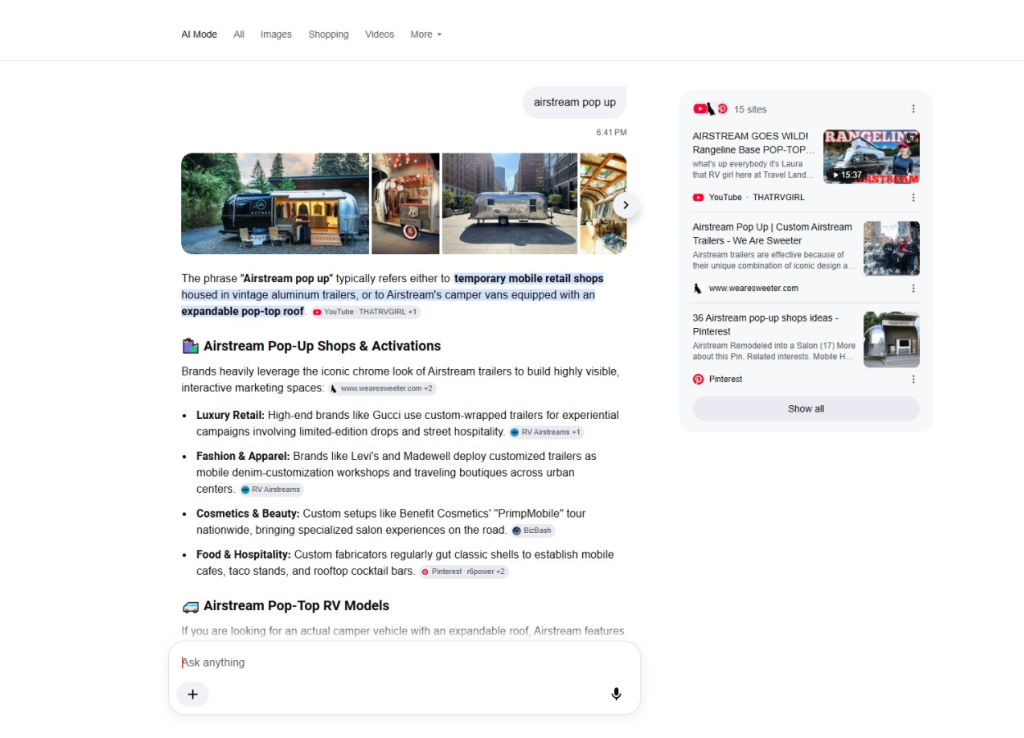
One example I often share comes from one of my clients, We Are Sweeter.
They are an experiential marketing company that specialises in branded Airstream trailers and other experiential marketing vehicles.
Today, their page is cited by Google AI Mode for the search term “airstream pop up.”
That didn’t happen because of keyword stuffing.
It happened because Google considers their content authoritative enough to answer the user’s question.
This is exactly where SEO is heading.
Winning isn’t just about ranking anymore.
Winning means becoming the trusted source AI chooses to reference.
If I Had to Allocate My Marketing Budget Today
Businesses often ask me whether they should continue investing in SEO or move entirely towards AI optimisation.
My answer is both.
However, I would adjust the balance.
If I were allocating a marketing budget today, I would invest:
- Approximately 40% in traditional SEO.
- Approximately 60% in AI optimisation and brand visibility.
Businesses have invested in SEO for years.
That foundation still matters.
But the biggest opportunity today lies in building authority that AI platforms recognise and trust.
What I Would Do in the First 90 Days
If I were launching a new campaign today, my first ninety days would focus on establishing authority.
My priorities would include:
- Publishing brand-focused content.
- Expanding FAQ sections across important service pages.
- Producing original case studies.
- Publishing press releases.
- Building high-quality backlinks through outreach.
- Securing placements on authoritative industry blogs.
- Strengthening author profiles and business credibility.
Every action would support one objective.
Build a brand that AI trusts.
What Businesses Should Stop Doing
Businesses need to stop chasing shortcuts.
Cheap SEO.
Cheap backlinks.
Mass-produced content.
Keyword obsession.
These tactics may have produced results years ago, but they are becoming increasingly ineffective in an AI-first world.
Building a respected business takes years.
Building digital authority works exactly the same way.
Trust cannot be manufactured overnight.
What Businesses Should Start Doing Today
The biggest mindset shift is this:
Stop thinking about your business as another competitor trying to rank for keywords.
Start thinking about becoming the brand that AI trusts enough to recommend.
That means investing in:
- Brand building.
- Reputation management.
- Google reviews.
- Digital PR.
- High-quality content.
- Author profiles.
- Thought leadership.
- Case studies.
- Genuine expertise.
The companies that consistently demonstrate authority across multiple channels will become the businesses AI references first.
My Prediction for the Future of SEO
Over the next three to five years, I believe the businesses that win will be those that actively place their content where their audience spends time.
That means investing beyond traditional SEO.
Social media.
YouTube.
Digital PR.
Brand content.
Industry publications.
Reviews.
Reputation management.
These channels all contribute to one thing:
Trust.
Google, ChatGPT, Claude and other AI platforms are all trying to answer one question.
“Which business can we trust to provide the best answer?”
The businesses that answer that question convincingly will dominate the next generation of search.
Final Thoughts
I don’t believe Google’s AI Mode signals the end of SEO.
I believe it marks the beginning of a better version of SEO.
Keyword rankings still matter.
Organic traffic still matters.
Backlinks still matter.
But trust matters more than ever.
Businesses that continue focusing only on rankings will eventually struggle.
Businesses that invest in building genuine authority, demonstrating expertise and becoming recognised brands will thrive.
Google’s AI Mode is ultimately built around one principle.
If you can prove your experience, expertise, authority and trustworthiness, Google won’t just rank your website.
It will recommend your brand.